2026
urushi, Kanshitsu,WARON,Gorld leaf
150×120×25
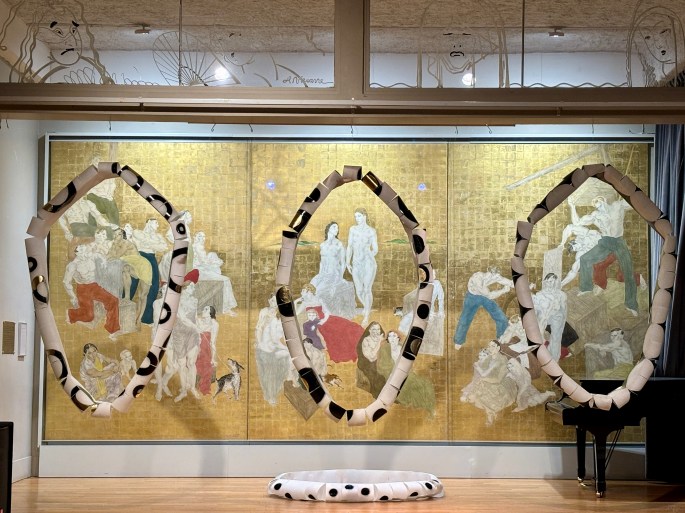
Cercle de Vie et de Retour
Statement (English)
Cercle de Vie et de Retour explores the cycle of life through the symbolic form of the circle. Its rim functions simultaneously as an entrance and an exit—a threshold where beginnings and endings, encounters and departures, continuously transform into one another.
The work is inspired by Léonard Foujita’s mural L’Arrivée des Occidentaux au Japon at the Maison du Japon, Cité Internationale Universitaire de Paris. In this mural, Foujita depicts Nagasaki as the gateway through which Western civilization entered Japan—a place where people, cultures, and artistic traditions encountered one another.
Using urushi, a traditional Japanese material with a long cultural history, I reinterpret this historical gateway as a contemporary threshold. The work connects Japan and France, tradition and the present, while reflecting on the circulation of life, memory, and culture.
For me, the circle is not a symbol of an ending, but an entrance leading toward the next life, the next culture, and new encounters.
ステートメント(日本語)
**《Cercle de Vie et de Retour》**は、「円」を生命の循環を象徴する形として捉えた作品です。円の縁は入口であり出口でもある境界であり、始まりと終わり、出会いと別れ、生と死が絶えず循環する場を表しています。
本作品は、パリ国際大学都市日本館にある藤田嗣治《西洋人の日本到来(L’Arrivée des Occidentaux au Japon)》から着想を得ています。この壁画では、長崎は日本と西洋を結ぶ歴史的な入口として描かれ、人や文化、芸術が出会い、新たな関係が生まれる場所として表現されています。
私は、日本の伝統素材である漆を用いることで、この歴史的な「入口」を現代へと読み替えました。この作品は、日本とフランス、伝統と現在を結びながら、生命だけでなく、記憶や文化もまた循環し続けることを表現しています。
私にとって円環は、終わりを示す形ではなく、次の生命や文化、そして新たな出会いへとつながる入口なのです。

